
.avif)
.png)
The General Product Safety Regulation (GPSR) became applicable across the European Union on 13 December 2024, replacing the previous General Product Safety Directive.
The regulation updates the EU product safety framework to reflect online sales, online marketplaces, and increasingly complex supply chains. It also introduces clearer requirements around product identification, economic operator responsibilities, product recalls, and the availability of product information.
Understanding the GPSR helps businesses prepare not only for current product safety obligations, but also for the growing role of product information across future EU legislation.
The General Product Safety Regulation (EU) 2023/988 establishes general safety requirements for consumer products placed or made available on the European market.
It replaces the previous General Product Safety Directive and applies directly across all EU Member States.
The regulation was introduced to address developments that were not fully reflected in the previous framework, including e-commerce, online marketplaces, and new ways products are sold and distributed across the European market.
The GPSR functions as a horizontal safety framework that applies to consumer products placed on the EU market unless sector-specific legislation already regulates the same safety aspects.
Where specific legislation exists, the GPSR only applies to risks that are not already covered by those requirements.
The regulation applies regardless of whether products are sold through physical retail channels or online.
Several elements of the previous framework were expanded or clarified under the new regulation.
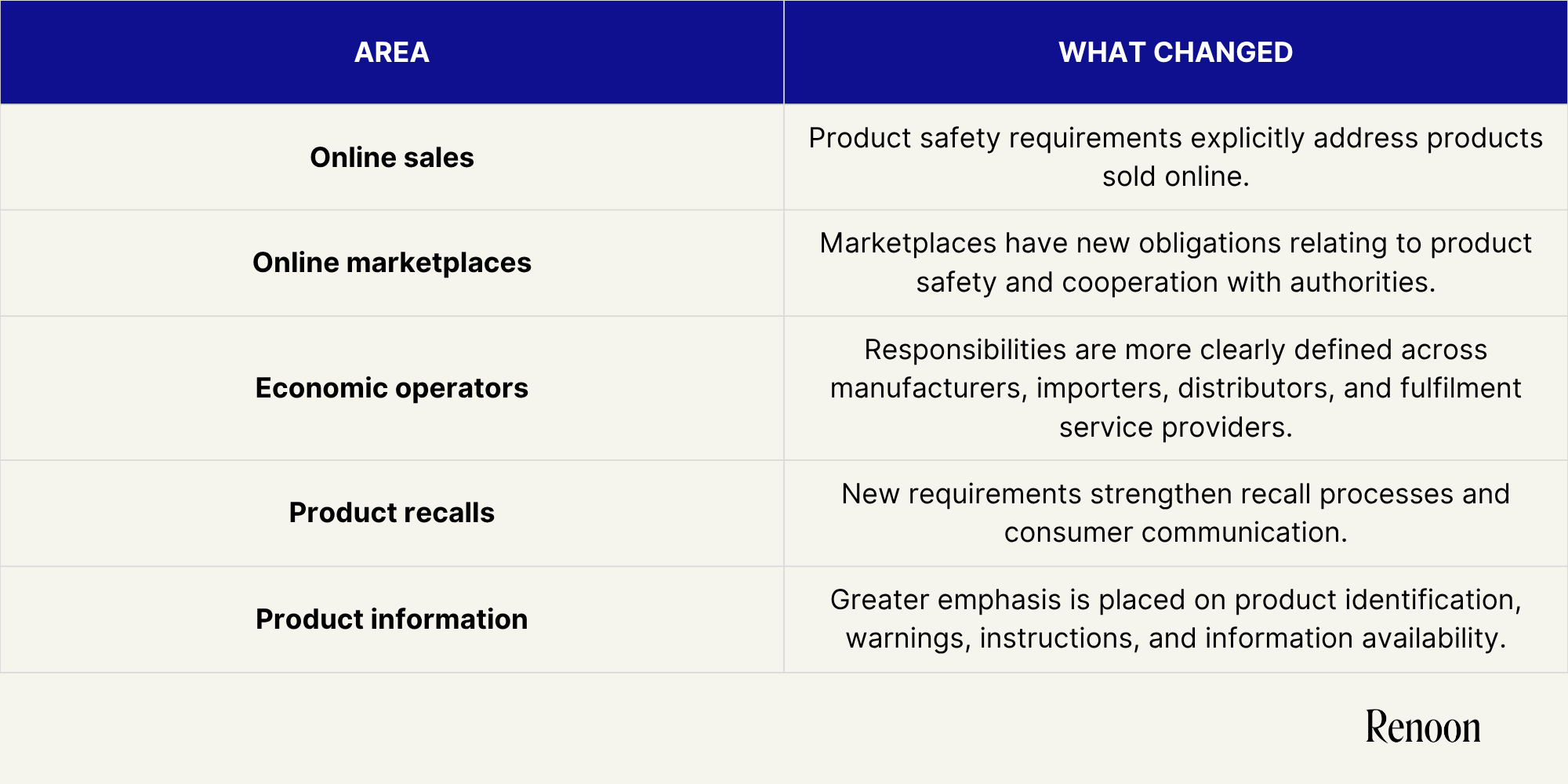
These changes reflect how products are increasingly sold, distributed, and monitored across digital and cross-border markets.
The GPSR establishes responsibilities for multiple actors involved in placing products on the market.
Depending on their role, manufacturers, importers, distributors, fulfilment service providers, and online marketplaces all have specific obligations under the GPSR. These include ensuring products can be identified, providing the required safety information, cooperating with market surveillance authorities, and taking corrective actions when safety risks are identified.
The regulation places particular emphasis on ensuring that a responsible economic operator can always be identified and that relevant product information is available when required.
Depending on the product and sales channel, businesses may need to provide information such as:
For products sold online, much of this information must already be available before purchase, reflecting the growing importance of digital product information within the European market.
Together, these requirements illustrate a broader shift in EU legislation: product information is becoming an increasingly important part of product compliance.
The GPSR focuses on product safety, but similar information-related requirements are also appearing in newer frameworks such as the Ecodesign for Sustainable Products Regulation (ESPR). Digital Product Passports build on the same principle by making product information available through a structured digital system.
For this reason, the GPSR provides an early example of how product information is becoming a more visible part of compliance across the European market.
GPSR already allows certain product information to be provided in digital format through electronic technical solutions, provided it remains clearly visible and accessible to consumers. The regulation recognizes that digital solutions can support the communication of mandatory product information, even though they cannot replace all information required to be physically provided with the product.
While this is different from the Digital Product Passport introduced under the ESPR, both frameworks reflect the same broader direction: compliance increasingly depends on structured, accessible, and well-managed product information.
For organisations preparing for Digital Product Passports, this means that strengthening product information management today can also support existing GPSR obligations. While the GPSR does not require a Digital Product Passport, many of the processes needed to comply with both regulations depend on maintaining reliable product information throughout the product lifecycle.
Regardless of future Digital Product Passport requirements, businesses should already know where key product safety information is stored and how it is maintained. This typically includes:
For textile products specifically, manufacturers are also expected to maintain documented risk assessments, testing results, manufacturing controls, and technical documentation for up to ten years after products are placed on the market.
Get in touch to assess whether your existing product information can support both GPSR compliance today and future Digital Product Passport implementation.


.png)
.avif)
.avif)