
.png)
One of the most common questions companies ask when preparing for the Digital Product Passport is who will be responsible for it. To what extent are suppliers responsible for DPP? The manufacturer and brand? What about the wholesalers and distributors?
The Ecodesign for Sustainable Products Regulation (ESPR) does not assign that responsibility to a single organisation. Instead, it distributes obligations across the economic operators involved in placing a product on the EU market and, where applicable, throughout its lifecycle. Which responsibilities apply depends on the role each operator performs.
This approach reflects how products are manufactured, imported, sold and managed in practice. The company designing the product, the importer placing it on the EU market, the distributor making it available to customers and the service provider hosting the passport all have different responsibilities under the regulatory framework.
The ESPR identifies several categories of economic operators, including manufacturers, importers, authorised representatives, distributors, dealers and fulfilment service providers. Future delegated acts for specific product groups will determine exactly which actors create the Digital Product Passport, which information they are allowed to add or update, and which data they can access.
Rather than requiring every company to perform the same tasks, the framework allocates responsibilities according to each operator’s role in placing products on the market. Some operators are responsible for creating and maintaining the passport. Others verify that required information is available before products reach customers. Others support the technical operation of the system without becoming responsible for product compliance.
This distribution allows product information to remain connected to the organisations that generate and maintain it, while ensuring that responsibilities remain clearly identifiable throughout the value chain.
Some of the terminology used in the ESPR differs from the language commonly used in the fashion industry. Understanding these definitions helps clarify which responsibilities apply to your organisation.
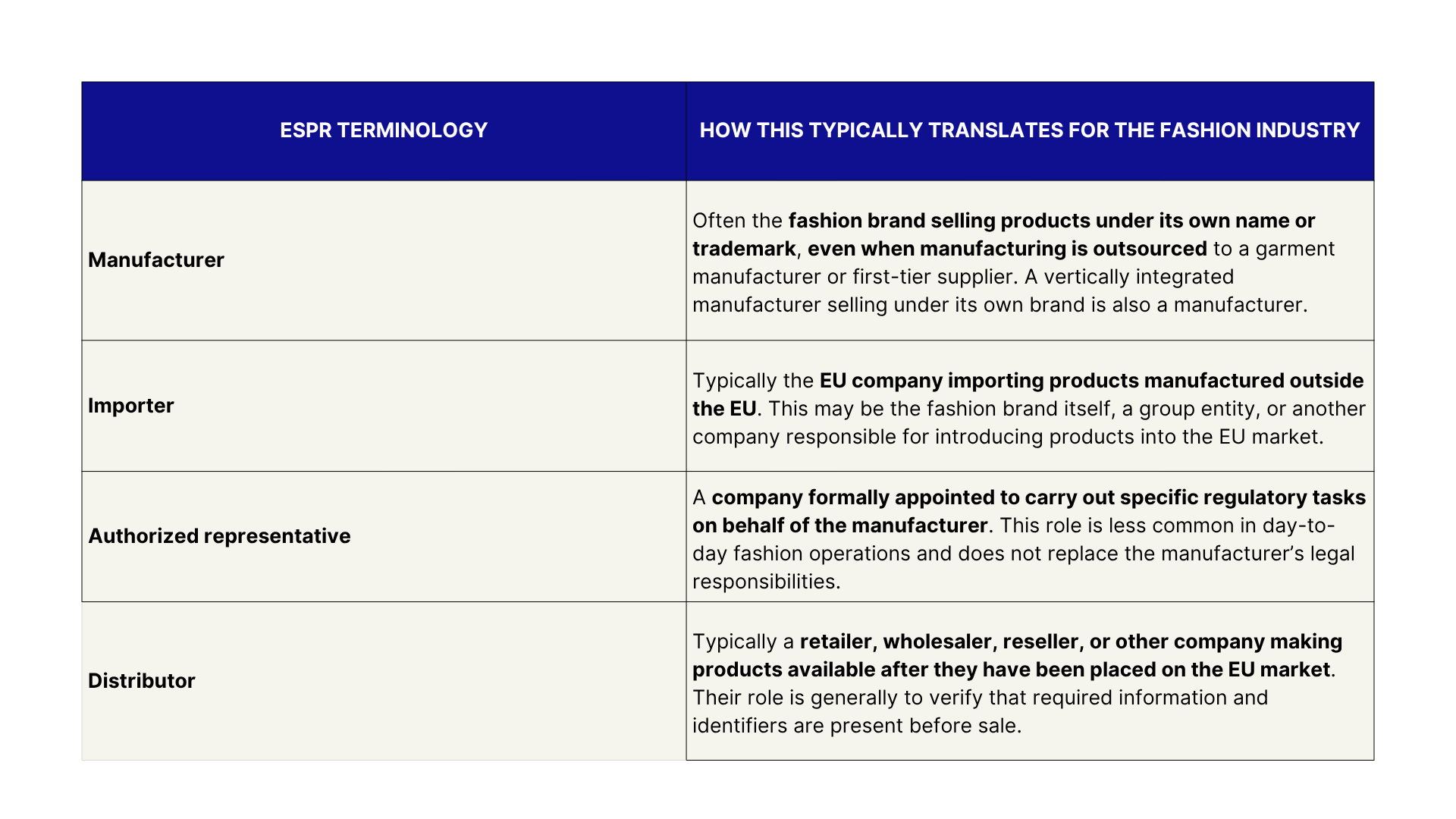
For products manufactured within the European Union, the manufacturer carries the primary responsibility for the Digital Product Passport.
The manufacturer is responsible for compiling the required product information, ensuring that the data is accurate, complete and up to date, registering the passport in the EU Digital Product Passport Registry where required, and making sure that the product is linked to its persistent unique product identifier through the appropriate data carrier. Registration is a prerequisite for placing products covered by DPP requirements on the EU market.
The manufacturer also remains responsible for maintaining the passport throughout the period defined in the applicable delegated act. As product information changes during the lifecycle, the Digital Product Passport must continue to reflect the latest authorised data.
Not every product sold in Europe is manufactured by a company established in the European Union.
When a manufacturer is established outside the EU, the importer placing the product on the Union market assumes the responsibilities normally assigned to the manufacturer under the ESPR. This ensures that there is always an identifiable economic operator responsible for meeting the Digital Product Passport obligations applicable to that product.
In practice, this means importers cannot rely solely on documentation received from non-EU suppliers. They must ensure that the Digital Product Passport satisfies the applicable legal requirements before the product is placed on the European market.
Distributors have a different role within the Digital Product Passport ecosystem.
They are not responsible for creating or maintaining the passport. Instead, before making products available on the market, they must verify that the required identifiers and information are present, including access to the Digital Product Passport where this is required by the applicable product legislation. If a distributor knows, or has reason to believe, that a product does not comply with the applicable requirements, it must not make that product available until the issue has been resolved.
This verification responsibility creates an additional compliance checkpoint before products reach customers.
The ESPR also assigns responsibilities to organisations that facilitate the sale and distribution of products.
More broadly, the Digital Product Passport must remain digitally accessible throughout the product lifecycle wherever access is required under the applicable legislation. This includes making the passport available online, not only through the physical data carrier attached to the product.
When products are sold through online marketplaces, the Digital Product Passport must be accessible to potential customers, including in distance selling scenarios. To enable this, the economic operator placing the product on the market must provide marketplaces with a digital copy of the data carrier or the persistent unique product identifier, or a webpage link where appropriate.
Fulfilment service providers also have responsibilities linked to their role in placing products on the market. However, these responsibilities do not replace those of the manufacturer or importer, which remain responsible for compliance with the applicable legislation.
The ESPR distinguishes between the organisation responsible for the product and the organisation providing the Digital Product Passport service.
Digital Product Passport service providers can host the passport, register it onto the Registry, store backup copies, and provide the technical infrastructure required for its availability over time. The Regulation also empowers the European Commission to establish specific technical and certification requirements that these service providers will need to satisfy.
Importantly, hosting the passport does not transfer responsibility for the product data itself. The accuracy, completeness and compliance of the information remain the responsibility of the relevant economic operator defined by the applicable legislation.
Before selecting software, connecting enterprise systems or defining product data, organisations need to understand which legal responsibilities apply to their role within the value chain.
The Digital Product Passport is built on a distributed governance model. Manufacturers, importers, distributors, marketplaces and service providers each contribute different functions that together support the availability, accessibility and management of product information. The exact responsibilities for creating, updating and accessing the passport will continue to be defined through product-specific delegated acts, but the governance model established by the ESPR already provides the foundation for implementation across future product groups.
If you’re defining how these responsibilities apply across your organisation, Renoon can help you translate regulatory requirements into an implementation roadmap.



.png)
.png)
.avif)