
.png)
Repair is becoming a central principle of European product legislation. Alongside the Ecodesign for Sustainable Products Regulation (ESPR), the EU Right to Repair Directive aims to extend the lifetime of products by making repair services easier to access, more transparent and more attractive for consumers. Rather than replacing existing product legislation, it complements the EU’s broader framework on product durability, reparability and circularity.
The Directive (EU) 2024/1799 was adopted on 13 June 2024 and entered into force on 30 July 2024. Member States were required to transpose it into national law and apply those measures from 31 July 2026. From that date, manufacturers of products covered by EU reparability requirements are subject to new obligations designed to make repair a more practical and accessible option for consumers.
For brands, the Right to Repair is part of a broader regulatory shift. EU product legislation is increasingly extending beyond the point of sale, with greater emphasis on durability, repairability and the availability of product information throughout a product’s lifecycle. Understanding how the Right to Repair interacts with the ESPR and Digital Product Passports is becoming an important part of preparing for upcoming regulatory requirements.
The Right to Repair Directive (Directive (EU) 2024/1799) establishes common EU rules to make repair a more accessible and attractive option for consumers, both within and beyond the legal guarantee. Its objective is to extend the lifetime of products, reduce premature disposal and support more sustainable consumption.
Rather than creating a standalone framework, the Directive complements existing EU product legislation. It works alongside the Ecodesign for Sustainable Products Regulation (ESPR), which introduces product-specific requirements for durability and reparability, and the Empowering Consumers for the Green Transition Directive, which strengthens the information consumers receive about product durability and repairability before purchase.
The obligation to repair does not apply to all products. It covers products for which EU legislation already establishes reparability requirements, primarily under the ecodesign framework.
Annex II of the Directive lists the product categories currently covered. The list will be updated as new reparability requirements are introduced through future EU legislation.
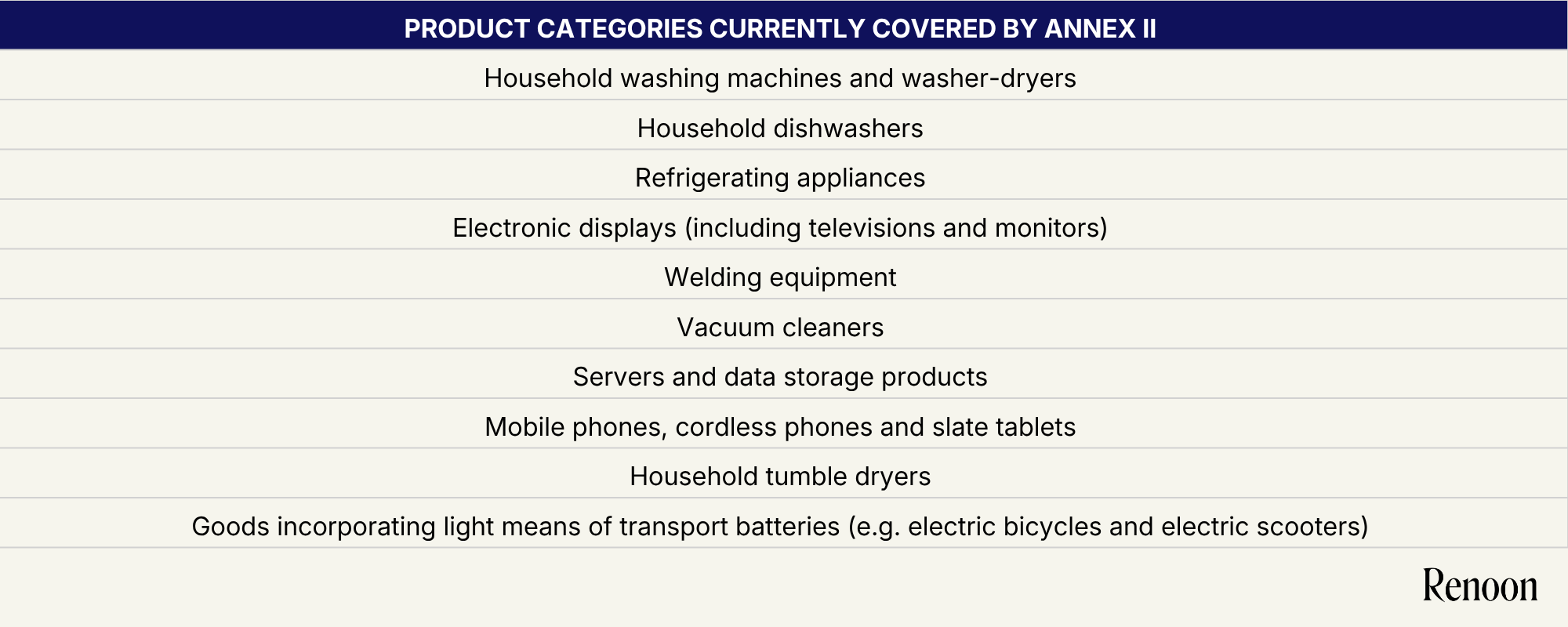
The list above reflects the product categories currently covered by Annex II of Directive (EU) 2024/1799. The European Commission is required to update Annex II as new EU legislation introduces repairability requirements for additional product groups, meaning the scope of the Directive will expand over time.
For products covered by the Directive, manufacturers will be required to offer repairs within a reasonable time and at a reasonable price. They must also provide consumers with easily accessible information about their repair services and make spare parts available, where required under applicable EU legislation, under reasonable conditions for the duration of their repair obligation.
The Directive also prevents manufacturers from using contractual terms, hardware or software techniques that unnecessarily prevent independent repair, unless these restrictions are justified by legitimate and objective factors. In addition, manufacturers cannot refuse to repair a product solely because it has previously been repaired by another repairer or by the consumer.
To make repair offers easier to compare, the Directive introduces a voluntary European Repair Information Form. The standardised form allows repairers to communicate key information, including the proposed repair, price, completion time and any additional services, in a consistent format across the EU.
Consumers will also benefit from a new European Online Platform for Repair, foreseen to become operational in January 2028. Integrated into the Your Europe portal, the platform will help users identify repair services, refurbishment providers and community repair initiatives across Member States.
Finally, if consumers choose repair instead of replacement during the seller’s legal guarantee period, an additional 12 months will be added to the remaining legal guarantee period once the repair has been completed. This extension applies only once, although Member States may introduce more favourable national rules.
The Right to Repair Directive and the Ecodesign for Sustainable Products Regulation (ESPR) are distinct legislative instruments, but they form part of the same policy objective: extending product lifetimes and improving resource efficiency across the European Union. While they operate in different ways, they are designed to work together.
The ESPR establishes the framework for introducing product-specific ecodesign requirements through delegated acts. Depending on the product group, these requirements may address characteristics such as durability, reparability, access to spare parts, repair information and other product performance criteria.
The Right to Repair Directive builds on these product requirements by focusing on what happens after a product is placed on the market. For products already subject to EU reparability requirements, it introduces measures that make repair more accessible to consumers, including obligations for manufacturers to offer repairs, greater transparency around available services and tools to help consumers identify repair providers.
Together, the two instruments address complementary aspects of product longevity. The ESPR establishes how products should be designed and supported throughout their lifetime, while the Right to Repair Directive strengthens consumers’ ability to keep those products in use through accessible repair services.
The Right to Repair Directive does not introduce Digital Product Passports, nor does it require repair information to be provided through a Digital Product Passport.
However, the ESPR establishes Digital Product Passports as the mechanism for making product information available digitally for product groups covered by future delegated acts. Among the information that may be required through a Digital Product Passport are data supporting product repairability, including information related to spare parts, maintenance and repair, depending on the requirements defined for each product group.
As these requirements are introduced, organisations will need to establish processes for collecting, managing and maintaining repair-related product information alongside other Digital Product Passport data. Rather than treating repair information as a separate compliance exercise, manufacturers can prepare a structured product data foundation that supports multiple regulatory requirements over the product’s lifetime.
For organisations preparing for Digital Product Passport implementation, the Right to Repair reinforces the importance of making repair information available in a structured, accessible and digital format over time.
Want to understand how repair information can be integrated into your Digital Product Passports? Explore our Digital Product Passport resources or speak with our team about structuring and digitalising repair-related product information for long-term compliance and customer access.


.avif)
.avif)