

This article reflects the current status and will be updated as new regulatory and standardisation developments are released. Last updated: October 2026.
Products sold in one market are often designed, manufactured and sourced across several others. As Digital Product Passport requirements take shape, the data behind them will therefore need to move across companies, systems and jurisdictions.
The emerging global DPP landscape does not consist of one common regulation or implementation model. Different markets and sectors are developing their own policies, infrastructures and technical approaches, while international organisations work to make them interoperable.
Understanding how these initiatives relate to one another can help international businesses build product-data systems that respond to European requirements without becoming limited to a single market.
The Ecodesign for Sustainable Products Regulation establishes the European Union’s horizontal DPP framework.
Product-specific delegated acts will define which products require a passport and determine their mandatory data, granularity, access rights, timelines and other requirements. The system is supported by European technical standards and a common EU DPP Registry.
Because these requirements concern products placed on the EU market, their operational impact extends beyond Europe. Manufacturers and suppliers in other countries may need to provide the information required for the DPP when their products enter the European market.
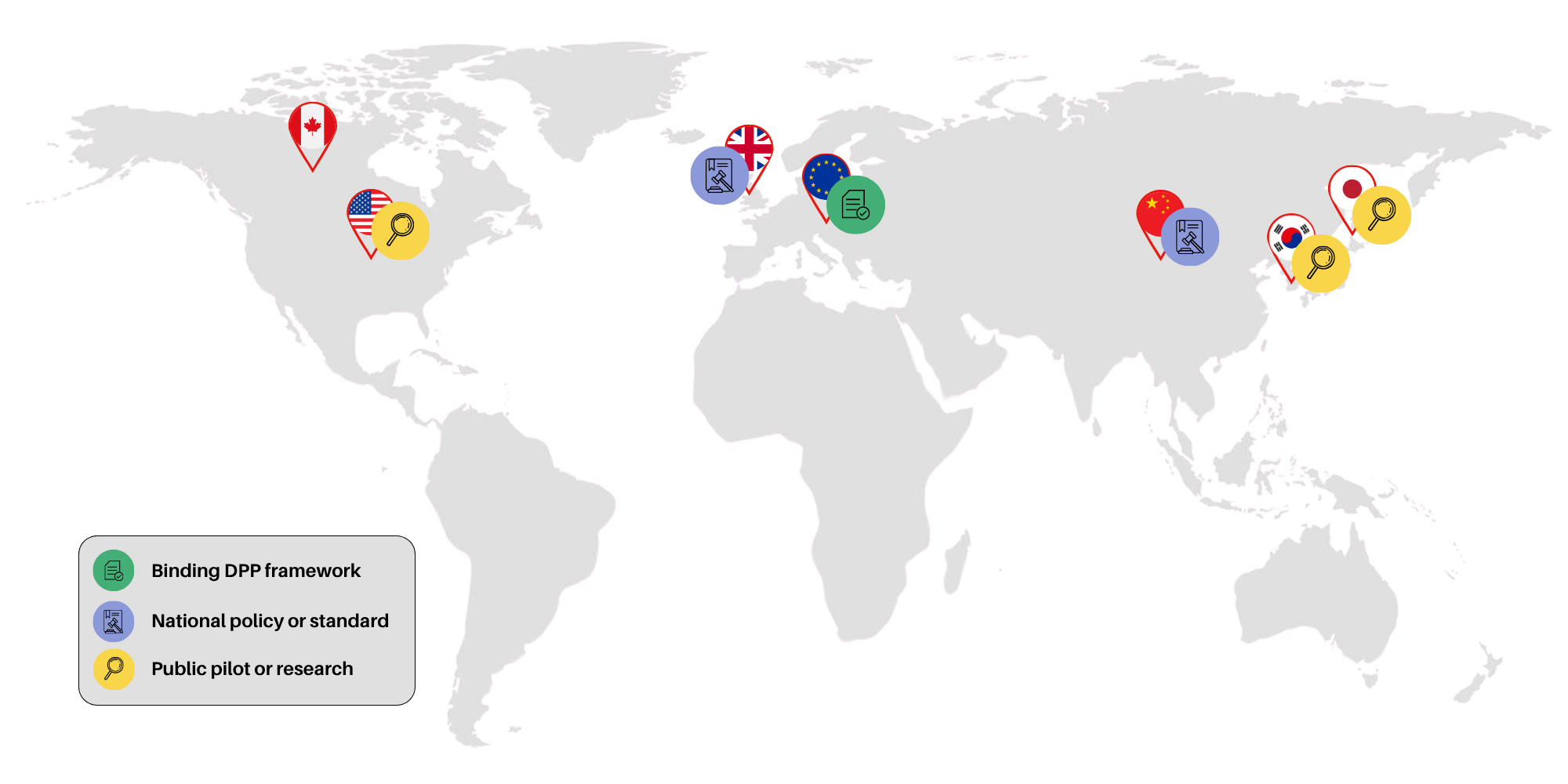
China is developing one of the most substantial DPP ecosystems outside the European Union.
A proposed Chinese national standard on the general requirements for Digital Product Passports covers principles, participants, business processes, identifiers, data carriers, data requirements, information sharing, access control, storage, security and authentication.
Its official documentation states that the project considers European DPP requirements alongside existing international and Chinese standards.
Parallel initiatives address batteries, automotive components, textiles, recycled materials and other industrial products. These projects connect DPP development with wider Chinese priorities around carbon-footprint management, circularity, trusted data spaces and digital trade.
Technical work presented by Chinese organisations also considers components such as digital signatures, verifiable credentials, blockchain, APIs, privacy-preserving technologies and different identification systems.
China’s approach should not yet be described as a binding, cross-sector DPP law equivalent to the ESPR. It is better understood as a developing national technical and industrial ecosystem, currently concentrated in strategic sectors.
The UK government has completed a call for evidence on a possible Digital Product Records policy.
The initiative explored whether product records could streamline regulatory information for businesses and improve transparency and traceability for consumers and market-surveillance authorities. It also considered the impact of EU DPP requirements on UK businesses.
The government has not yet determined its approach for Great Britain. The position is different in Northern Ireland, where relevant EU requirements will apply under the Windsor Framework. UK businesses selling products in the European Union will also need to comply with the applicable EU rules.
The UK therefore represents national policy exploration rather than an established mandatory DPP framework.
In Japan, the government-supported PLA-NETJ project is developing requirements and rules for sharing information across the plastics value chain.
The initiative examines European DPP developments while defining data formats, security requirements and access controls for domestic collaboration. It includes demonstrations intended to support a roadmap for broader implementation.
The programme is linked to Japan’s objectives for plastics reuse and covers value chains such as automotive, household appliances, packaging and construction materials.
It illustrates how DPP models can first emerge through sector-specific information-sharing systems, rather than through a horizontal product passport law.
The United States does not currently have a horizontal federal DPP framework comparable to the ESPR.
The National Institute of Standards and Technology has, however, conducted research into electric-vehicle battery passports. Its work examined provenance, manufacturing history, sustainability information and the circular management of battery materials, as well as the technical challenges affecting implementation.
Other standards and industry initiatives are addressing battery traceability, critical minerals and digital product information.
The US landscape is therefore characterised by sector research and industry-led development rather than a general federal DPP obligation.
Busan was selected for a South Korean public-sector blockchain programme to establish a battery passport platform.
The project includes pilot services covering charging and safety, performance inspection and lifecycle management. It is intended to support battery data management and prepare local companies for emerging international requirements.
This is a public and operational initiative, but it should not be interpreted as a national, cross-sector DPP mandate.
The Canadian government has explored the combination of Digital Product Passports and verifiable digital credentials to improve supply-chain transparency and reduce fraud.
A federal innovation challenge called for systems capable of digitising supply-chain documents, authenticating information and operating across more than one product domain. It explicitly referred to technologies such as decentralised identifiers and W3C Verifiable Credentials.
Canada has also supported G7 work on the interoperability of digital credentials and DPP-compatible systems for critical-mineral supply chains.
This represents government-backed experimentation around trust and interoperability, rather than a national DPP mandate.
DPP development is not taking place only through governments. Some of the most advanced initiatives are emerging within international value chains.
These projects are important because product data rarely originates within one company or jurisdiction. It may need to move from raw-material suppliers to manufacturers, importers, retailers, repair providers and recyclers.
Batteries currently represent the most mature passport use case.
The EU Batteries Regulation introduces mandatory battery passports for relevant battery categories from February 2027. At the same time, the Global Battery Alliance is developing a global sustainability reporting and certification scheme intended to launch in 2027.
Its work covers supply-chain data, assurance and greenhouse-gas information, alongside an interoperable digital infrastructure designed to connect with internal and commercial third-party solutions.
The two developments have different roles:
Participation in a voluntary global scheme does not automatically establish EU compliance. However, it may help create shared data and verification structures that can support requirements across markets.
Catena-X is developing an open, standardised and vendor-independent environment for exchanging data across the automotive value chain.
Its DPP use case connects manufacturers, suppliers and service providers through a federated data space. Participating organisations retain control over their information and share it according to common technical and governance rules.
Catena-X shows that a Digital Product Passport is only as reliable as the supply-chain infrastructure that provides its data.
The customer-facing passport may be the visible result, but its operation depends on identifiers, supplier information, permissions, validation and connections between different company systems.
Fashion and textile supply chains frequently span several countries and tiers of production.
UNECE and UN/CEFACT have been working on traceability and transparency for garment and footwear value chains, including the exchange of information through digital credentials. This work is increasingly connected with the United Nations Transparency Protocol and broader global DPP development.
For fashion companies, this matters because a product may be designed in Europe, assembled in another market and contain materials or components sourced from several additional countries.
Compliance may be triggered by the market where the product is sold, but much of the information needed for its passport must be collected internationally.
As national and sector initiatives expand, markets could develop incompatible identifiers, data models and technical infrastructures.
International standardisation aims to reduce this fragmentation. It does not replace product legislation or define the mandatory dataset for each category.
ISO/IEC JTC 5 is the international committee dedicated specifically to Digital Product Passports.
Its scope covers the foundations of the DPP system and ecosystem, with the objective of enabling interoperability across sectors and systems. It does not intend to duplicate sector-specific standards already developed by other ISO and IEC committees.
Its initial work programme includes:
These projects remain under development. There is not yet a published standard in this new ISO/IEC DPP series against which a solution can claim compliance.
UN/CEFACT is developing a project on Digital Product Passport Overview and Fundamental Principles, building on UNECE’s experience with trade facilitation, traceability and cross-border data exchange.
The United Nations Transparency Protocol provides specifications for publishing and exchanging verifiable sustainability and trade information. It is a protocol rather than a central platform, allowing organisations to maintain their existing systems.
In a DPP context, this can help connect:
The objective is to make information reusable across value chains and jurisdictions without requiring all participants to adopt the same software.
GS1 is developing how its identification, barcode and data-sharing standards can support Digital Product Passports.
This work is operationally important because many companies already use GS1 identifiers and data carriers throughout manufacturing, logistics and retail.
Reusing recognised identification systems can help prevent the creation of isolated DPP identifiers that cannot be interpreted by existing supply-chain systems. GS1 standards may support the connection between a product and its passport, while legislation determines which information must be included.
Meeting EU requirements will not automatically make a DPP compatible with every international system. Companies should therefore build on portable product data, interoperable identifiers and adaptable access rules, so that the same foundation can support different markets and sector requirements.
Renoon helps companies structure product and supply-chain data, connect existing systems and implement Digital Product Passports designed to evolve across products and markets.
Speak with our team about your Digital Product Passport project.