

Disclaimer: Renoon's team may hold important internal information about, or maintain direct relationships with, some of the companies referenced in this analysis. However, none of this internal knowledge or these relationships has been taken into account, in any shape or form, for the purpose of this document. The findings presented here are based exclusively on the publicly available corporate reporting reviewed as part of this research.
How far has the fashion industry already moved on Digital Product Passports?
The answer in one sentence: Renoon found that 9 of 20 fashion brands, or 45%, explicitly mentioned Digital Product Passports in their 2025 sustainability reporting, while only 3 of 20, or 15%, reported DPPs already live on products.
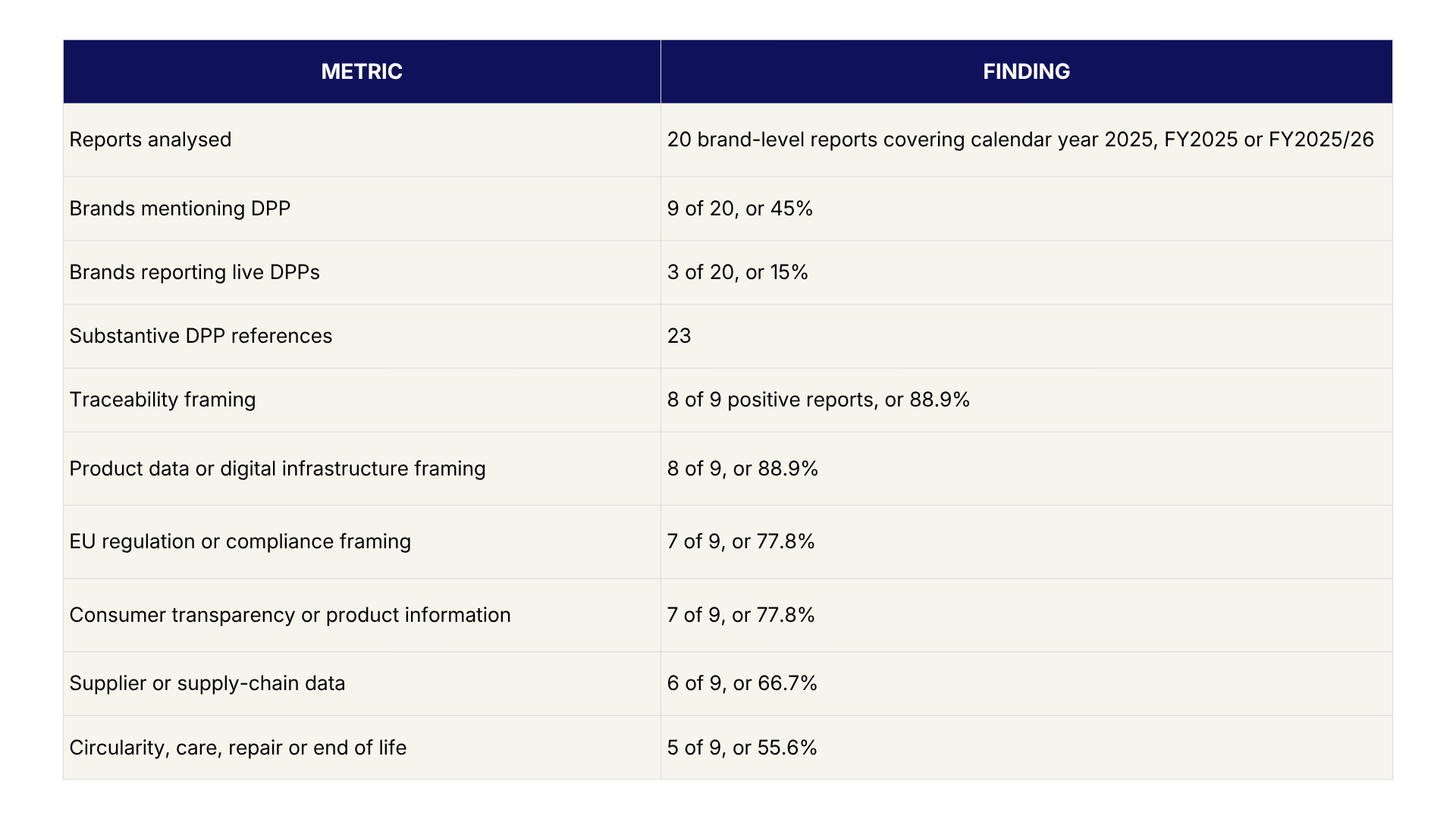
Renoon reviewed 20 official, brand-level sustainability, impact and ESG reports covering calendar year 2025, FY2025 or FY2025/26.
The analysis excluded parent-group reports, general annual or integrated reports, previous-year publications and external corporate sources. The comparison therefore focuses on what individual brands disclosed in the selected sustainability reports.
Each report was searched for explicit references to “Digital Product Passport”, “Digital Product Passports”, “DPP”, “DPPs”, “product passport”, “product passports”, “digital passport” and “digital passports”.
Every occurrence was checked in context. Duplicate references, table-of-contents entries and definition-only mentions were excluded from the substantive count.
This research measures public disclosure. A report classified as having no DPP mention means that Digital Product Passports were not explicitly discussed in the selected publication. It does not establish whether the brand is preparing, testing or implementing DPP through activities disclosed elsewhere or not publicly reported.
Among the nine brands that mention Digital Product Passports, eight connect DPP with product traceability and eight with product data or digital infrastructure. Both themes therefore appear in 88.9% of the positive reports.
Seven brands, or 77.8%, explicitly connect DPP with EU regulation, compliance or regulatory readiness. Consumer-facing information also appears in seven reports. Six discuss supplier or supply-chain data, while five connect DPP with circularity, care, repair or end-of-life.
The reports frame DPP primarily through the operational work required to create and maintain product-level information.
ASICS states that the forthcoming EU DPP requires additional supply-chain information and the preparation of the necessary IT systems. (Sustainability Report 2025, p. 56)
Decathlon connects product-passport compliance with product-data management and its traceability programme. (2025 ESG Report, pp. 65 and 72)
Yamamay links DPP development with a new PLM and with more transparent, traceable and data-led product processes. (Sustainability Report 2025, p. 6)
Gucci discusses digital twins and the organisation of traceability and sustainability data to support DPP creation. (Gucci Equilibrium Impact Report 2025, p. 42)
GANNI describes work to connect design, production and repair systems as part of its goal to develop a DPP solution by 2028. (2025 Responsibility Report, “Innovation / Digital Innovation”)
Across these examples, implementation depends on the ability to associate reliable information with the correct product, exchange it between internal systems and suppliers, and maintain it at the required level of granularity.
The research identified 23 substantive DPP references across the nine positive reports.
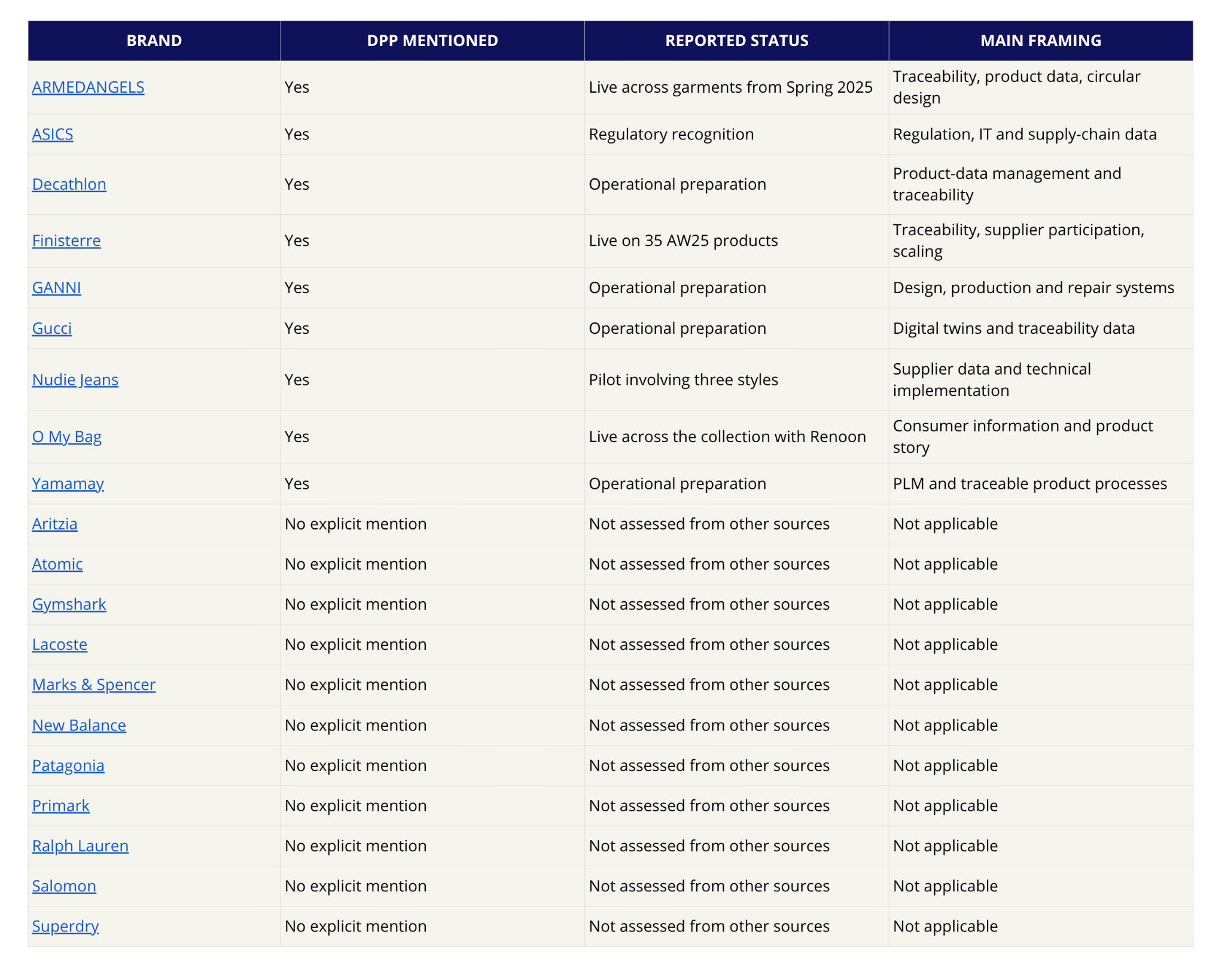
ARMEDANGELS accounts for seven substantive references, Finisterre for five and Nudie Jeans for three.
Together, these three brands account for 15 of the 23 substantive references, or approximately 65%.
This concentration shows that the 45% headline figure does not correspond to a consistent depth of disclosure. Several reports contain one isolated reference, while a smaller group provides repeated examples or dedicated sections covering pilots, implementation, supplier data and operational constraints.
Eight of the nine positive reports describe regulation, preparation, a pilot or active implementation. Three brands explicitly report DPPs already live on products or across a collection.
These are ARMEDANGELS, Finisterre and O My Bag. Together, they represent 15% of the full sample.
ARMEDANGELS reports that all garments from Spring 2025 carry a QR code providing product information, including certifications and manufacturers.
The report describes nine product-level data points already available, with further supplier, circular-design and carbon data planned. (Impact Report 2025)
Finisterre reports launching its first Digital Product Passports on 35 products from its AW25 collection using Retraced.
The report also describes the operational constraints encountered when scaling the project, including the work required to increase supplier participation and expand product coverage. (2025 Impact Report, pp. 15–16 and 48)
O My Bag reports introducing Digital Product Passports across its collection with Renoon.
Customers can scan a QR code to access information concerning the bag’s materials, makers, environmental footprint, care, guarantee and second-life options. (2025 Impact Report, “Digital product passport”)
Eleven of the 20 reports contain no explicit DPP reference.
The reports were published by Aritzia, Atomic, Gymshark, Lacoste, Marks & Spencer, New Balance, Patagonia, Primark, Ralph Lauren, Salomon and Superdry.
This result does not establish that these brands are inactive or unprepared. It shows that DPP had not become a standard subject in their selected 2025 sustainability reporting.
Public reporting is an incomplete indicator of operational readiness. Brands may be preparing internally, participating in external projects or working with technology providers without discussing those activities in the document analysed.
The distinction remains important for interpreting the results: this research measures what brands publicly disclosed in a defined set of reports.
The research identifies a clear difference between DPP visibility and disclosed implementation.
Digital Product Passports appear in 45% of the reports analysed. Traceability and product-data infrastructure are the most common themes among those reports. Live rollout is explicitly reported by 15% of the full sample.
The findings indicate that much of the disclosed work currently sits in the preparation layer:
These activities can begin before the final textile-specific requirements are adopted. The delegated act will determine the applicable data and access requirements, but companies can already assess the availability, ownership and quality of the information held across their organisation and supply chain.
DPP readiness depends on the ability to convert this information into a structured and maintainable product-level data layer.
Nine of the 20 fashion brands analysed by Renoon in a randomised sample, or 45%, explicitly mention Digital Product Passports in their 2025 or FY2025 sustainability reporting.
ARMEDANGELS, Finisterre and O My Bag explicitly report Digital Product Passports live on products or across a collection. Together, they represent 15% of the full sample.
The ESPR establishes the Digital Product Passport framework and identifies textiles and apparel as a priority. The detailed requirements and application date for the relevant textile product groups will be established through product-specific rules.
A fashion DPP can connect a persistent product identifier with information concerning materials, origin, supply-chain stages, certifications, care, repair, recycling, environmental performance and other data required by the applicable product rules.
The final mandatory information will depend on the relevant delegated act.
DPP rollout requires product-level information, supplier participation, system integration, identifiers, data governance and processes for maintaining information over time.
The reports show many brands working on these underlying requirements, while disclosed product-level rollout remains concentrated among three companies in the sample.
The reports show that DPP implementation already involves decisions about product data, supplier information, internal systems, identifiers and governance.
Renoon supports fashion companies across these decisions, from regulatory preparation and data-model definition to supplier onboarding, system integration and Digital Product Passport rollout.



.avif)
.avif)
.png)