

Artificial intelligence has become one of the most discussed technologies in fashion, often through applications in design, content generation and creative workflows. During Copenhagen Fashion Week’s Fashion and Technology panel with Vogue Business, however, the discussion focused on a different question: what happens when technology stops being a competitive feature and becomes part of the industry’s infrastructure?
Across AI, regulation and Digital Product Passports, one idea emerged consistently. Fashion is entering a phase where product information, rather than individual technologies, becomes the foundation connecting products, businesses and regulatory requirements.
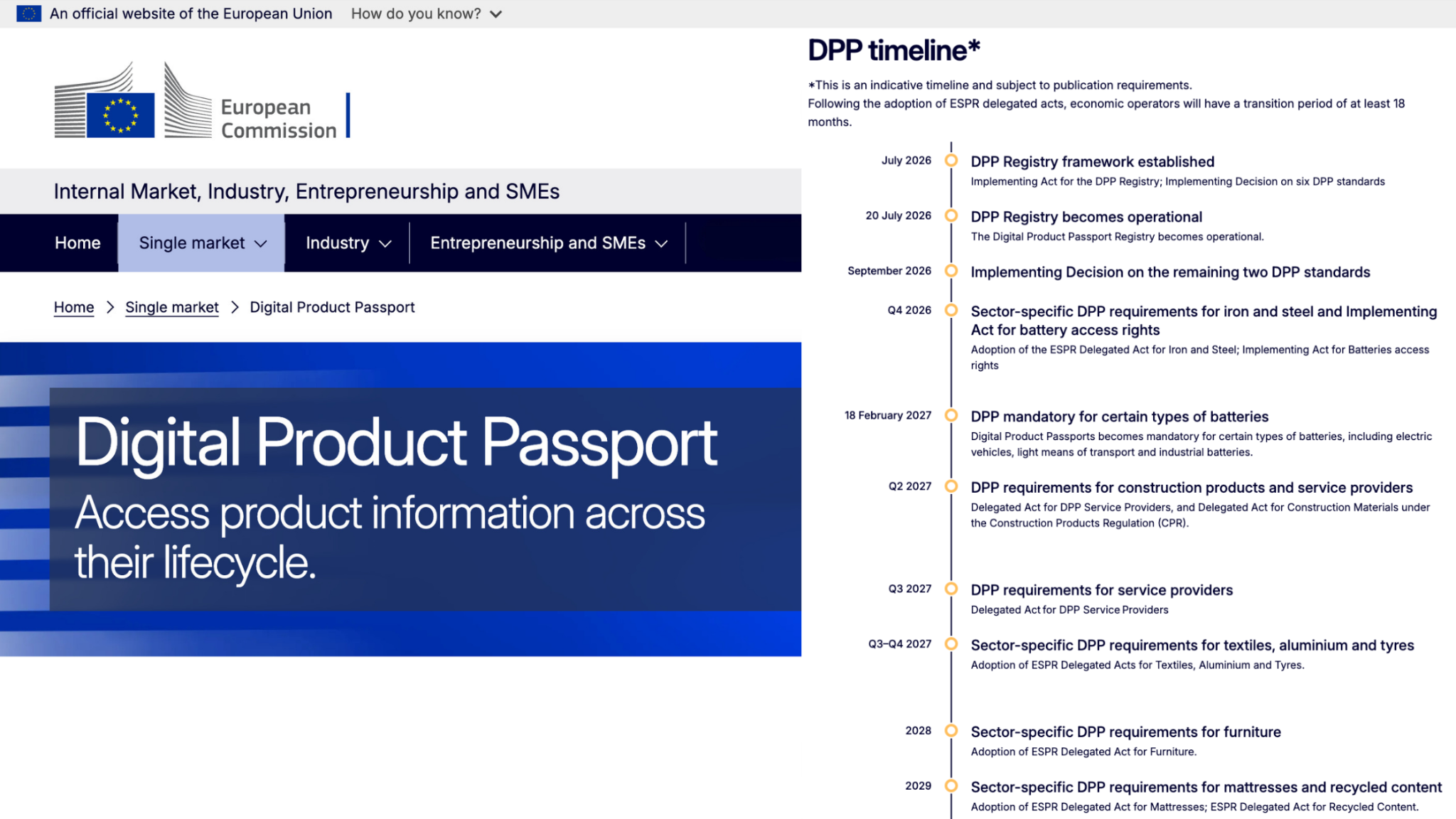
Under the Ecodesign for Sustainable Products Regulation, products covered by applicable delegated acts can only be placed on the EU market or put into service when the required Digital Product Passport is available. The passport must contain accurate, complete and up-to-date information, connected to a persistent unique product identifier and structured according to technical requirements designed to support interoperability. (Eur-Lex)
For fashion, this connects regulatory compliance directly to the ability to manage product information digitally. Product data needs to be collected from the relevant sources, maintained over time and made accessible to the actors entitled to use it. The European Commission also requires DPPs to be registered in the EU DPP Registry before products subject to those requirements are placed on the market.
Technology therefore becomes part of the operational foundation behind market access. For consumers, this infrastructure may only be visible through a QR code or another data carrier. Behind it sits a much broader system responsible for collecting, connecting and maintaining product information throughout the lifecycle.
A Digital Product Passport is often associated with the QR code attached to a product. The ESPR describes a broader system.
The data carrier connects the physical product to a persistent unique product identifier. Behind that identifier sits structured product information that must remain accessible and interoperable. The DPP itself follows a decentralised architecture: the EU Registry stores identifiers and selected metadata, while the underlying product information remains under the responsibility of the relevant economic operators and can be hosted through a DPP service provider.
For a fashion company, this requires connections between information that may originate in product development, sourcing, supplier documentation, certification records, ERP or PLM systems and other operational sources.
The customer-facing passport is therefore one output of a larger ecosystem. The underlying work is the continuous management of product information across systems, organisations and stages of the product lifecycle.
Throughout the discussion, AI was described less as a creative tool and more as a way to remove operational friction. Its role becomes particularly relevant where companies already have information but still depend on manual interpretation, repetitive checks or fragmented workflows.
In product-data and compliance processes, AI can support activities such as interpreting documentation, identifying information within unstructured files, classifying records and assisting with repeated assessments. The objective is to reduce the manual work required to use the information companies already receive and maintain.
This distinction becomes especially important for Digital Product Passports. The legal responsibility for DPP data remains with the relevant economic operator. AI can support the process used to organise and work with that information, while accuracy, completeness and compliance remain governed by the applicable regulatory framework.
The discussion also suggested that the most valuable AI is often the least visible.
For a brand, the relevant outcome is rarely the presence of an AI feature. It is whether documentation can be processed more consistently, repetitive tasks require less manual intervention, information can be managed across larger product portfolios and teams can focus on the cases that require judgement.
Copenhagen Fashion Week’s collaboration with Renoon illustrates this approach. Rather than replacing human expertise, AI supports the assessment of qualitative responses and documentation within an existing evaluation framework, making the process more scalable while preserving consistent decision-making.
The example illustrates a broader point: AI becomes operationally useful when it is embedded into a defined process, with existing rules, data and expertise around it.
Read more about the partnership between CPHFW and Renoon in the dedicated article.
One phrase from the Copenhagen Fashion Week discussion captured another challenge particularly well: fashion needs translation.
The industry brings together creative teams, sourcing departments, suppliers, compliance functions, technology systems, retailers and regulators. Each works with different information and different terminology.
Digital Product Passports create a requirement to make part of that information interoperable and accessible across organisational boundaries. The ESPR explicitly requires DPP data to use open standards, interoperable formats and data structures capable of being transferred through an open interoperable network.
This gives product data a broader role. The same structured information can support regulatory access, internal operations, supply-chain traceability and, depending on the applicable product requirements and access rights, information for customers, repairers, recyclers and public authorities.
The Digital Product Passport therefore becomes one mechanism through which different parts of the fashion ecosystem can interact with a shared digital representation of the product.
The Copenhagen Fashion Week discussion pointed to a future where technologies such as AI become less visible as standalone tools and more integrated into everyday business processes.
The same is happening with Digital Product Passports. While today they are often discussed as a new regulatory requirement, they intended to become a standard part of how product information is created, managed and shared across the fashion industry.
The focus therefore shifts from adopting individual technologies to building the product data foundations that allow those technologies to work together.
For fashion companies, preparing for Digital Product Passports is ultimately about more than implementing a passport. It is about establishing the information infrastructure that will support products throughout their lifecycle.
If you’re defining that infrastructure, Renoon can help connect your product data, enterprise systems and Digital Product Passport requirements into one implementation roadmap.


.avif)