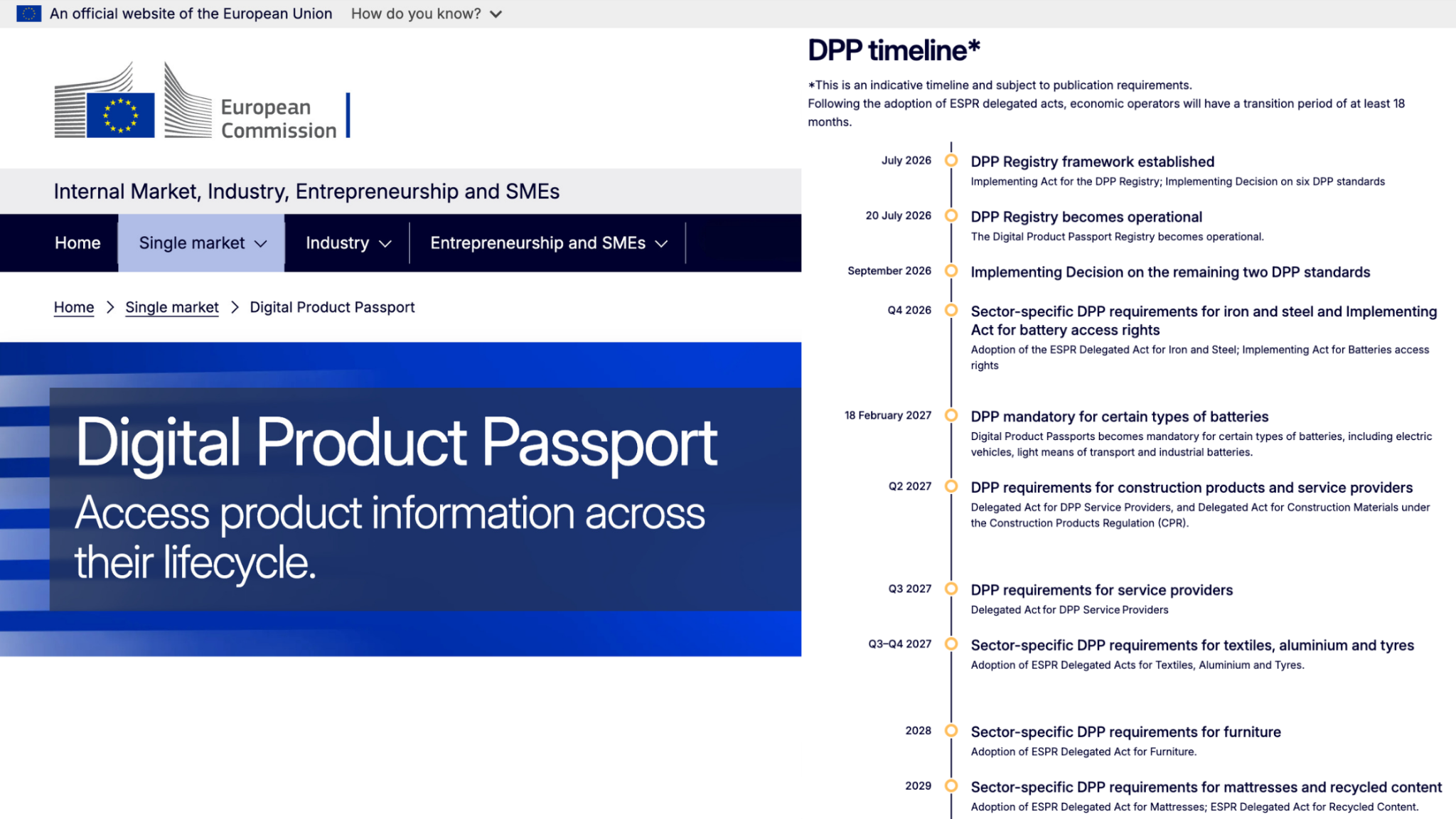

A Digital Product Passport does not begin when a customer scans a code after receiving a product. Under the Ecodesign for Sustainable Products Regulation, it must also be accessible before purchase, including when the product is sold online.
This brings Digital Product Passports directly into the e-commerce environment. Product pages will need to connect customers with the correct passport, while brands, retailers and marketplaces must coordinate identifiers, product variants and information across different systems.
The ESPR does not prescribe one mandatory interface. It does, however, establish the outcome that the e-commerce implementation must achieve.
The Ecodesign for Sustainable Products Regulation establishes that customers must be able to access the Digital Product Passport before entering into a contract for sale, including when purchasing a product online.
It also assigns specific responsibilities to the actors involved:
The European Commission’s DPP FAQs translate these provisions into a clear e-commerce expectation: online marketplaces will need to make the DPP easily accessible from the product page so that customers can consult it before purchasing. The Commission also clarifies that someone shopping on a laptop should be able to open the passport directly, without having to scan a QR code with another device.
The current requirement is therefore clear: the online product offer must provide easy access to the relevant Digital Product Passport before purchase.
Product-specific legislation will determine the remaining category-level details, including whether the DPP applies at model, batch or item level, which data carrier must be used and whether additional presentation rules apply.
The ESPR does not require a specific e-commerce interface. It requires the relevant Digital Product Passport to be easily accessible before purchase, including directly from the online product offer.
A brand, retailer or marketplace can meet this requirement through different technical implementations, including:
A widget can display selected passport information without taking the customer away from the product page. A dedicated microsite can provide access to the complete passport and present information according to the relevant user rights. The two solutions can also work together, with the widget acting as the entry point to the full DPP.
The interface must allow customers to open the passport directly from both desktop and mobile devices and must connect the online offer with the DPP corresponding to the product or variant being viewed.
This online access does not replace the data carrier required on the physical product, its packaging or accompanying documentation. The e-commerce interface and the physical data carrier are two access points to the same Digital Product Passport.
Renoon connects Digital Product Passports with e-commerce through branded integrations and dedicated passport interfaces. These touchpoints use the same product identifiers and structured data, creating a consistent experience across the product page and the passport while remaining aligned with the brand’s visual identity and customer journey.
A simple link can provide access to the correct passport. A more integrated experience can also turn the DPP into an additional e-commerce touchpoint: customers can explore product and supply-chain information, discover related products and access services such as registration, care, repair, warranty or resale. Compliance remains the foundation, while the interface and connected services create opportunities for engagement before and after purchase.
A reliable e-commerce integration must connect each product listing with the correct Digital Product Passport.
A product page may contain multiple colours, sizes, configurations or batches. Under the ESPR, each product-specific act must establish whether the passport applies at model, batch or item level. The e-commerce catalogue must therefore be able to associate each listing and selected variant with the identifier required at that level.
For example, if different variants are associated with different materials, suppliers or compliance information, a generic link covering the whole product family may not lead to the correct record. The destination may need to change when the customer selects a different variant.
This requires coordination between:
The page, the selected product variant and the Digital Product Passport must refer to the same product record.
This connection should also remain stable if the e-commerce platform, internal systems or DPP provider change. Existing links and data carriers should not become unusable simply because the underlying technology has been replaced. This makes DPP data portability and protection from vendor lock-in relevant to the e-commerce architecture as well.
The complete DPP does not need to be reproduced inside the e-commerce page. The online offer must provide clear access to the passport, while the passport remains the structured product record containing the information and access rights required by the applicable legislation.
Companies can surface selected DPP information directly within the product page, but this customer-facing layer must remain consistent with the underlying passport. Additional services such as product registration, care, repair, warranty or resale can be connected to the same product identity without replacing the mandatory DPP information.
E-commerce, PIM, PLM, ERP and DPP systems often use different product references and update cycles. A scalable implementation must define a source system for each data point and preserve the relationships between models, variants, identifiers, documents and passport records.
When information changes, the update must reach every relevant destination without creating conflicting versions of the same product data. This requires defined data ownership, validation responsibilities and integration flows rather than a separate DPP dataset maintained manually.
The DPP involves several actors with different responsibilities.
The relevant economic operator remains responsible for creating the passport, registering the required identifiers and ensuring that its information is accurate, complete and up to date.
A dealer offering the product must ensure that customers can access the DPP, including in distance selling. This can include a brand selling through its own website or a retailer selling products from several brands.
Online marketplaces must make the relevant DPP easily accessible from the product offer. To enable this, sellers and economic operators must provide the identifier, digital data carrier or webpage link needed to connect the listing with the passport.
This creates practical questions that companies should resolve before implementation:
In September 2026, CIRPASS-2 published two dedicated resources addressing DPP integration into pre-sale e-commerce environments. One provides recommendations for integrating passports into e-commerce, while the other maps the roles and obligations affecting economic operators, dealers, sellers and marketplaces across EU product, platform, consumer and data legislation.
From 1 November 2026, customs declarations for goods sold online and imported into the European Union must include three product references:
These identifiers allow customs authorities to connect imported goods with online offers, manufacturers and equivalent products sold through different platforms. According to the European Commission, they will support more precise risk analysis and help authorities identify products presenting similar compliance risks.
This requirement is separate from the DPP framework, but follows the same operational principle: online listings, manufacturer records, product identifiers and customs data must refer consistently to the same product.
For products subject to DPP requirements, customs will also verify the unique registration identifier and commodity code against the DPP Registry.
Further changes will follow with the EU Customs Data Hub in July 2028. Under VAT measures agreed by the Council and still subject to the remaining legislative steps, non-EU platforms will also become responsible for collecting VAT on goods sold into the EU. Together, these developments point towards greater platform responsibility and stronger alignment between e-commerce, product and customs data.
Companies can already assess whether their product catalogues, identifiers and system integrations can support direct access to Digital Product Passports before purchase.
They should verify:
These checks affect PIM, PLM, ERP, e-commerce and DPP systems, as well as the teams responsible for product data, compliance and online sales.
An effective e-commerce integration must maintain a reliable connection between the online offer, the selected product or variant, its identifier and the corresponding Digital Product Passport.
Renoon supports companies in connecting Digital Product Passports with existing product systems and customer touchpoints, including QR codes, dedicated passport interfaces and e-commerce integrations.
Speak with our team about integrating Digital Product Passports into your e-commerce environment.